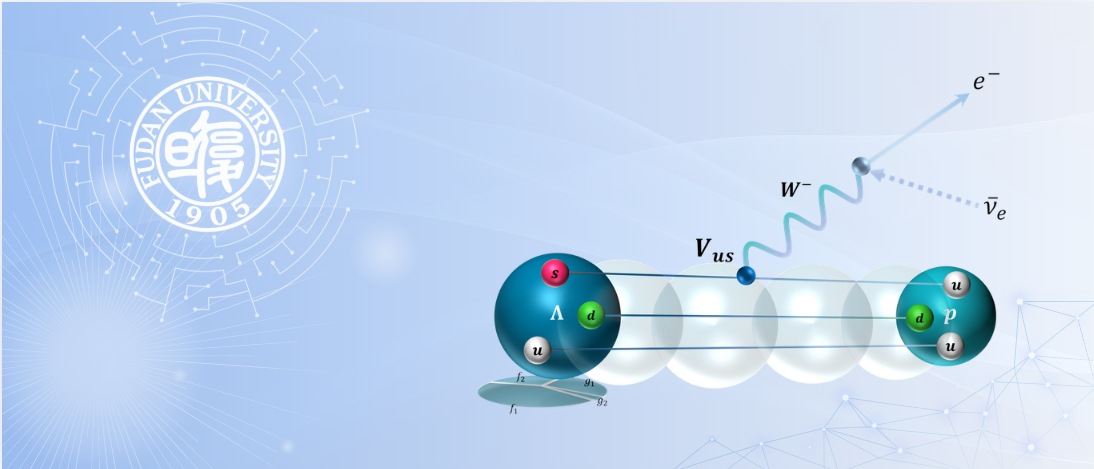


The BESIII Collaboration has performed the first study of a baryon semileptonic decay to exploit both polarization and quantum entanglement in Lambda-anti-Lambda pairs produced through J/ψ decay. The analysis determines key quantities for Λ → p e⁻ ν̄e and its charge-conjugate process, including the first determinations of the absolute branching fraction and weak-electric coupling in the Λ electron mode, and the first measurements of semileptonic transition form-factor ratios for an antihyperon. When combined with recent lattice-QCD calculations, the results give |Vus| = 0.2339 ± 0.0041, consistent with first-row CKM unitarity at 1.4 standard deviations. The study appears in Nature on 2 September 2026.
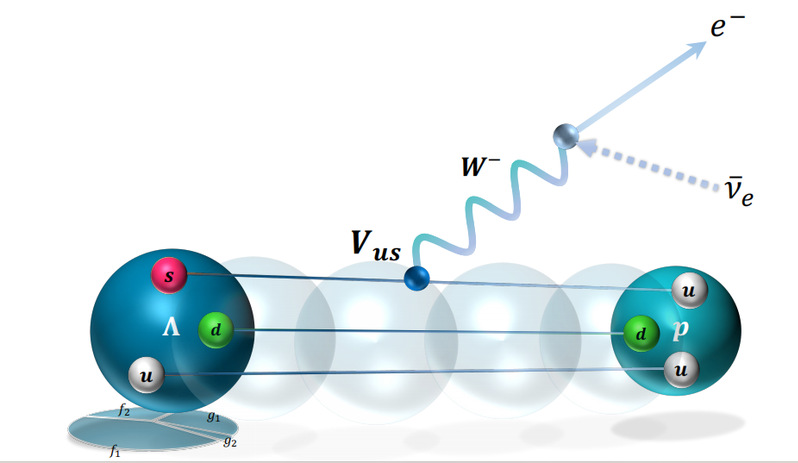
In the Standard Model, quarks can change from one type, or flavor, to another through the weak interaction. The probabilities of these transitions are encoded in the Cabibbo-Kobayashi-Maskawa (CKM) matrix, whose rows and columns must satisfy strict balance conditions known as unitarity. The element |Vus| describes the transition between strange and up quarks. Measurements based on kaon and tau decays do not all agree perfectly, and tests of the first row of the matrix show tension; this is not yet evidence of new physics, but it makes independent determinations especially valuable.
The Λ hyperon is a short-lived baryon made of one up, one down, and one strange quark. In its beta decay, the strange quark changes into an up quark as the Λ decays into a proton, an electron, and an electron antineutrino. The decay probability depends on both |Vus| and transition form factors - quantities that encode how the quarks bound inside the Λ respond to the weak interaction. Earlier experiments lacked enough kinematic information to disentangle these effects, and the most precise previous measurement of the Λ beta decay was made more than 30 years ago.
BESIII addresses this limitation by studying J/ψ → Λ anti-Λ, in which the two hyperons are produced together in a well-defined initial state. Their spin states are correlated through quantum entanglement. Reconstructing the visible decay on one side fixes the momentum of its partner, while the directions of the decay products provide information about the correlated spins. Energy-momentum conservation then allows the missing kinematics of the undetected neutrino to be inferred. A seven-dimensional joint angular analysis combines the production process, polarization, entanglement, and both decays in one framework. Inputs already measured by BESIII reduce the number of free physics parameters from six to three, allowing the data to yield more information per event.
The analysis used world largest 10 billion J/ψ events and identified about 1,800 signal events. The absolute branching fraction was measured to be B(Λ → p e⁻ ν̄e) = (8.16 ± 0.22 [stat.] ± 0.15 [syst.]) × 10⁻⁴, consistent with the world average. For the Λ, BESIII measured the axial-vector and weak-magnetism form-factor ratios and, for the first time in this decay, the weak-electricity ratio g₂/f₁ = −0.19, with a statistical uncertainty of +0.65/−0.63 and a systematic uncertainty of ±0.18. The weak-electricity result is consistent with zero, as expected in the flavor-SU(3)-symmetry limit, while the axial-vector and weak-magnetism results are compatible with lattice QCD. The analysis also provides the first semileptonic form-factor measurements for an antihyperon: separate axial-vector and weak-magnetism ratios from the charge-conjugate anti-Λ decay, obtained in a fit in which the weak-electricity term is fixed to zero. Although the Fermilab sample contained about 20 times as many signal events, BESIII achieved comparable precision on the weak-magnetism ratio and measured the weak-electricity ratio for the first time. The gain comes from exploiting polarization and quantum entanglement that had been overlooked or unaccessible in earlier experiments.
The BESIII collaboration extracted |Vus| in two complementary ways. Using exact flavor SU(3) symmetry to normalize the vector form factor gave |Vus| = 0.2194(94). Using recent first-principles lattice-QCD form factors instead gave |Vus| = 0.2339(41), consistent with CKM unitarity at 1.4 standard deviations. The team also determined |Vus|√(f₁² + 3g₁²) = 0.4496(75), the first such result in any baryon semileptonic decay. Under the assumptions specified in the analysis, this experimentally based combination reduces reliance on external theoretical form-factor inputs and provides a benchmark for future calculations.
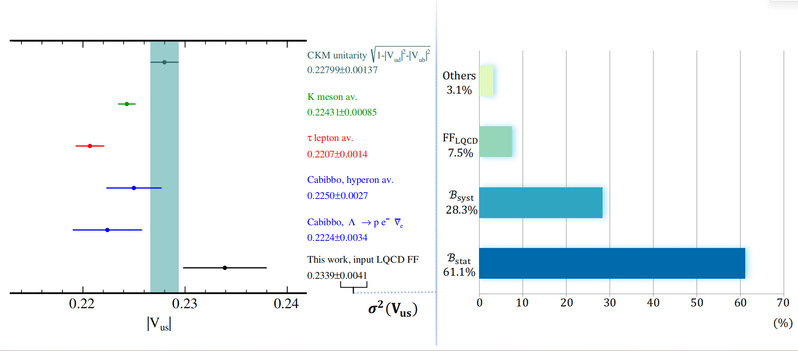
The result shows that quantum entanglement can serve not only as a phenomenon to observe, but also as a practical precision tool for decays with missing particles and limited statistics. BESIII is already extending the method to the following studies of other baryon semileptonic channels. Because form factors in different channels are related, combined measurements, together with improving lattice-QCD calculations, could eventually make hyperon-based determinations of |Vus| competitive with those from kaon decays. The approach is also applicable to facilities such as PANDA and proposed Super Tau-Charm Factories, broadening the ways collider data can test the Standard Model.
Journal information
Journal: Nature
Article title: Exploring baryon semileptonic decays through polarization and entanglement
DOI: 10.1038/s41586-026-10818-8
Publication date: 2 September 2026
BESIII website: http://bes3.ihep.ac.cn/
About BESIII
The Beijing Spectrometer III (BESIII) is a large, general-purpose particle-physics detector operating at the Beijing Electron Positron Collider II (BEPCII) at the Institute of High Energy Physics, Chinese Academy of Sciences. Its international collaboration comprises approximately 700 scientists from about 96 research institutions in 15 countries. The experiment focuses on precision physics in the tau-charm energy region and has produced world-leading results in hadron spectroscopy, charm physics, tau physics and searches for physics beyond the Standard Model. The work of the BESIII detector and BEPCII accelerator teams, together with the offline-software and computing teams, was essential to collecting and analyzing the data used in this study.
(END)
Editor: LI Yijie